

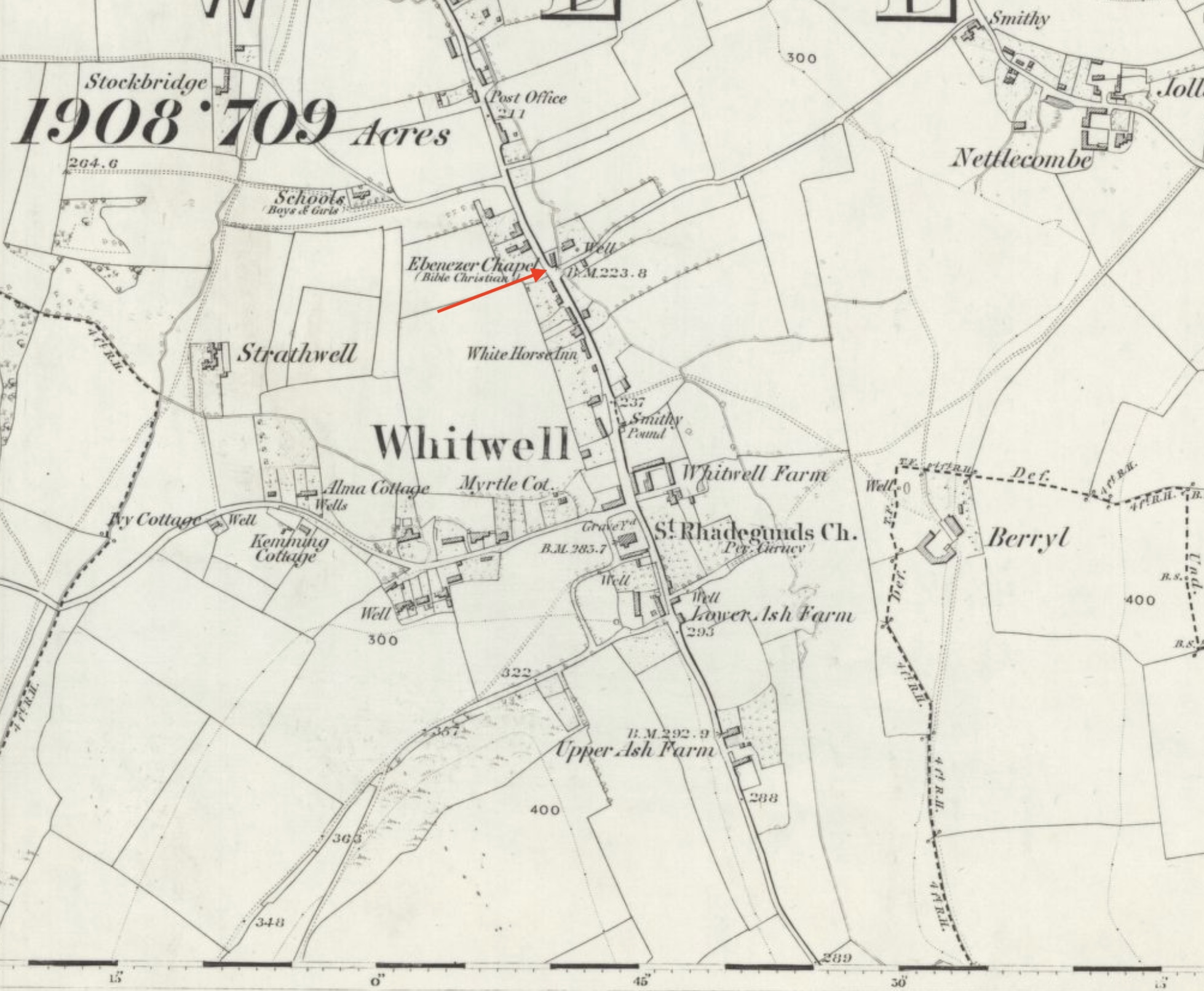
The Isle of Wight was a Bible Christian stronghold, but it appears from this account of the opening of the chapel at Whitwell that evangelsing the island had been a struggle to start with. A Society was set up in Whitwell in 1834, and by 1840 they were ready to build. This is the account of the opening:
“A new Chapel, 37 feet by 21, was opened for divine worship, at Whitwell, in the Isle of Wight Circuit, on Sunday, May 22nd, 1840, when two sermons were preached by Brother J. Barnden. Sermons were also preached and Collections made in behalf of the building the following Sunday; when the Rev. J. Smedmore, Baptist, and Mr. J. Salter, Methodist, kindly assisted. The Collection was about £8. It was not so much as we expected, which circumstance may be accounted for by our having made two public collections in behalf of the same object before:—-one on the 28th of April, 1839, when a Sermon was preached on the foundation stone, and another when we had what the tradesmen call, “The Rearing.” This took place as soon as the roof was up; when instead of having intoxication drink, about 120 persons sat down together to a friendly cup of tea;—after which a public meeting was held, and a blessed feeling appeared to pervade the minds of all present.
Whitwell, is a church village, eight miles south of Newport, bearing to what is termed “The back of the Island;” it had been for a great number of years a place notorious for Sabbath-breaking, swearing, smuggling, and drunkenness, and especially for its determined opposition to the preaching of the Gospel by Dissenters. The servants of the Lord in attempting to preach the Gospel in the place, have been hooted at, and pelted with clods, stones, rotten eggs, &c. Fifty years ago the Methodists made an attempt to establish preaching, and preached just where our Chapel now stands, and succeeded in getting into a house in the Village of Nettlecombe, (a village just by,) where they continued to preach for sometime; but the old people of the house dying, and there being no person disposed to receive them any longer, the place was again abandoned to its course for a number of years. When the Bible Christians opened their mission on the Island, they made an attempt to introduce the preaching of the gospel into that neighbourhood; but the tide of opposition ran so strong, that it was again given up.—But it is pleasing to know that, although our friends at that time, met with great persecution, good was done. M. O’Bryan, (now Mrs. Thorne) was besmeared with rotten eggs, &c. there; and J. S. who had been a Sergeant in the army, a good man, who was then a Local Preacher among us, when preaching there, was challenged by a man, to fight: the man had a stone in his hand; but J. S. with strong voice, spoke out with authority, “We’ll pray first.” While they were praying, the poor sinner appeared to tremble, and the stone dropped out of his hand. W. J. who is now a local Preacher among us, and a class-leader at the new Chapel, received his first awakening by their labours, about that time.
In the year 1834, our friends made another attempt to establish the worship of God in the place, and took a barn, (for which we have given £3 18s a year rent,) and fitted it up for preaching. This place soon became crowded with hearers; a society was formed; a Sunday School was established; and a great reformation soon took place, both in the village and neighbourhood. But as the place was very wet and cold in the winter, and not large enough to contain the people who were disposed to hear, it became very desirable to get a chapel. When Brother Moxley laboured in the Circuit, he agreed with Mr. S. for a spot of land for building, for which he was to give £10, but nothing had been done more towards the building, when at the Conference 1838, I was again appointed to the Isle of Wight Circuit. As materials for building are very dear in that neighbourhood, we decided on presenting a petition to the Right Honourable, the Earl Yarborough, for a grant of stones with which to build. These circumstances were very encouraging, and led us to hope that our object would soon be accomplished. Nevertheless after this, from circumstances more unfavourable, the work was delayed; our minds were painfully exercised on the subject; and some who were not very friendly began to speak slightingly of us in consequence; but we made our cause known to God in prayer, and he undertook for us, and enabled us to accomplish our purpose.
The Chapel is substantially built with stone, covered with slate, in a good situation, and the premises are considered to be worth about £200. The stones and sand were given, and nearly all the cart work done gratis, by the farmers in the neighbourhood, more than ten of whom, to their praise be it spoken, sent their teams on the occasion, to draw the materials; so that with what has been collected, leaves a debt of a little more than £100 on the premises. We put in about 70 sittings which were let at once, at 9d. each; and many more are wanted. On the whole we have much cause for gratitude to God, that the Chapel is built; it is placed in easy circumstances, and we have every reason to hope it will be made a blessing.
R. Sedwell, Penryn, September 21st, 1840 “
The new chapel seems to have been a success, as on March 30th 1851 they counted congregations of 130 in the morning, 230 in the aftenoon and 200 in the evening. By 1884 they were ready to rebuild the chapel. A Sunday School followed in 1929, but both closed in 1998.
Any further information on the chapels in Whitwell would be greatly welcomed.
Sources
Bible Christian Magazine for 1841 pp23-24
The National Archives HO129/99/66
No Comments
Add a comment about this page