
Silver Street UMFC chapel was built in 1864 to replace an earlier chapel which stood on the same site. In his Directory of 1872 White described the new building thus:
“The present large commodious structure was erected, at a cost of £3500, from designs by Bellamy and Hardy. The font elevation is of white brick, and has two side entrances, and a large central window within a deeply recessed arch, flanked by massive coupled Corinthian columns of Mansfield stone, which support small vases. The sides and back are also of brickwork, with two tiers of windows; the lower being square headed, and the upper semicircular. The building which is suitably fitted up with pews, and a well arranged gallery running tound the whole interior , contains 800 sittings and an efficient organ supplied by Nicholson, at a cost of £235.
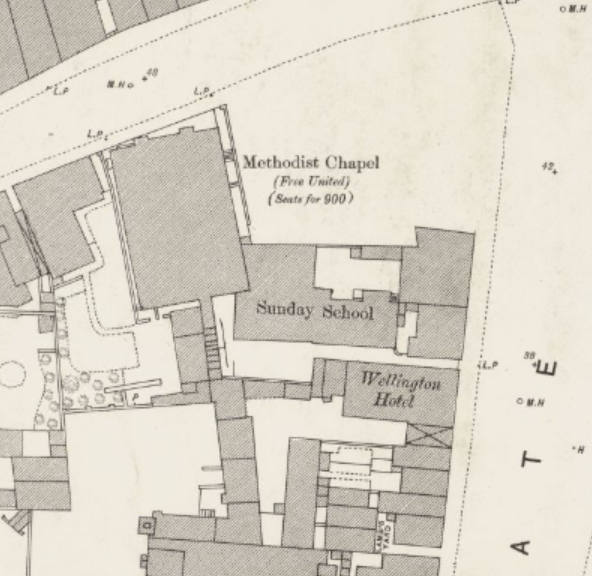
In 1940 the chapel seated 900 in pews, there were two school halls and seven other rooms. The chapel had been closed by 1970. Silver Street chapel was situated on the south side of Silver Street between School Lane and Broadgate
Sources
White’s Directory of Lincolnshire, 1872, p 76-77
John Rylands Library University of Manchester, MAC Lawson, Methodist Church Buildings: Statistical returns including seating accommodation as at July 1st 1940 No. 702 Lincoln, Trinity Circuit
The Methodist Church Department of Chapel Affair, Statistical Returns made 6th December 1970
OS Town Plan Lincolnshire LXX.7.12 ‘
Lincoln, Silver Street United Methodist Free Church chapel, Lincolnshire
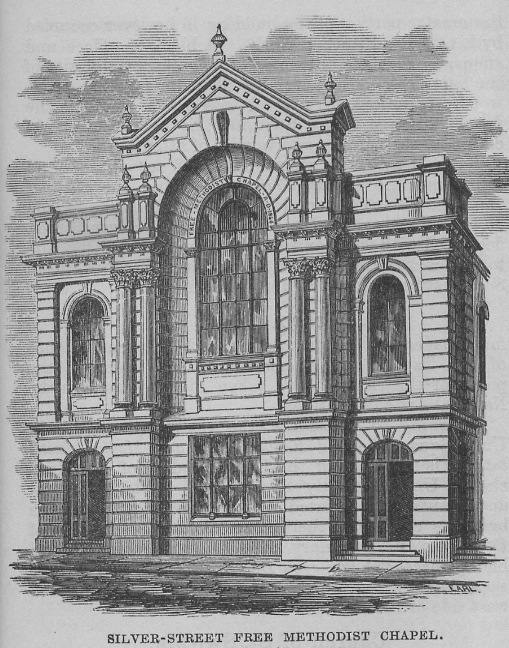
Silver Street Free Methodist Chapel, Lincoln
- Akrill's Visitor Guide to Lincoln,1880, Public Domain, https://commons.wikimedia.org/w/index.php?curid=61935066
Comments about this page
The final service in this chapel was held on 29th September 1940, according to the Society for Lincolnshire History and Archaeology. The First World War memorial from Silver Street was rediscovered and is now in All Saints church in Lincoln. See this page and look for All Saints
The 1940 list marks this as ‘S’, meaning “in use on 1 July 1940, but sold* before the list went to press in or about 1947”
*and presumably, therefore, closed, though this is not spelt out
Bellamy, Pearson (1822-1901) and Hardy, John Spence (1814-1892) They were an important Lincoln based practice, and there is a full account of their work here:
https://en.wikipedia.org/wiki/Bellamy_and_Hardy
Their work for the various strands of Methodism was as follows:
1854 Louth, Lincs, Eastgate UMFC
1860 Martin by Timberland, Lincs, WM
1860 Grimsby, Cleethorpe Road, Victoria WM
1860 Market Rasen, Lincolnshire, Union Street WM
1863 Lincoln, Newport UMFC
1864 Lincoln, Silver Street, Zion UMFC
1865 Stallingborough, Lincs, WM
1865 Sedbergh, Yorkshire WM
1865 Leighton Buzzard, Beds., Hockcliffe Road WM
1865 Boston, Lincs., West Street WM
1866 Goulceby, Lincs. WM
1866 Keelby, Lincs. WM
1868 Grantham (Little Gonerby), Lincs., Chapel Street UMFC
1869 Hackthorne, Lincs. WM
1869 Swinderby, Lincs. WM
1872 Wildmoor, Lincs, New York Wesleyan chapel, Dogdyke Road
1874 Sibsey, Lincs., Main Road WM
1875 Lincoln, High Street, Hannah Memorial WM
1875 Kirkstead, Lincs. WM
1877 Binbrook, Lincs. High Street WM
1878 West Ashby, Lincs. WM
1878/79 Spalding, The crescent/Spring Gardens UMFC
1879 Lincoln, Bailgate WM
1880 Retford, Notts., Grove Street WM
1884 Lincoln, Portland Street Mission WM
1885 Willingham by Bow, Lincs WM
What a remarkable building. The architect seems to have thrown everything in the ornamentation pattern book at this facade. But who was he? Can other examples of his chapel work be identified?
A drawing of the chapel has been added.
Add a comment about this page