
Morecambe took off as a resort during the second half of the nineteenth century, with the development of the railway system. The town became known as Bradford on Sea, because families would come down for a holiday, and the husbands and fathers would be able to commute to work in Bradford on a Monday morning and return to their familes in Morecambe at the weekends.
S.W. tells us in his article (in the UMFC Magazine in 1881) about the new church in Morecambe that “There are few places which have exercised greater claims upon tourists and holiday-seekers during the past few years than this rising and salubrious watering-place. … The town is not only pleasantly situated, but it stands almost unequally for its climatic superiority” He quotes one medical authority on how little disease is to be found in the town, that the death rate is particualrly low, and that the temperature averages are two degrees milder than the south. Having, no doubt, pocketed his fee from the local tourist board he goes to say “It will be pleasing to the friends throughout the Connexion to learn that we, as a denomination, are represented in this healthy and favourite place.”
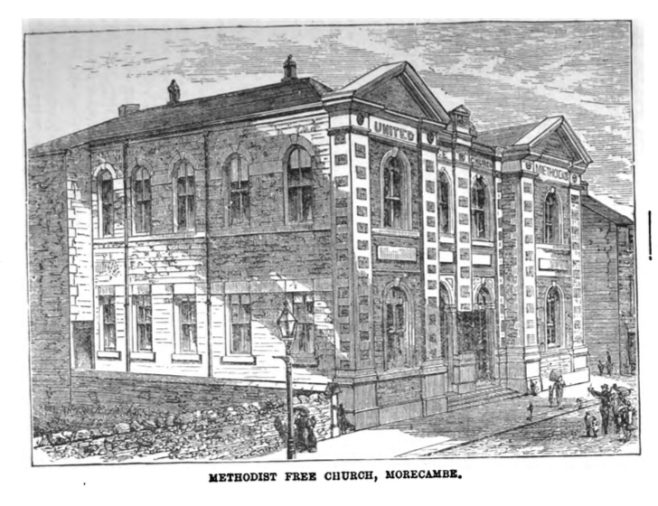
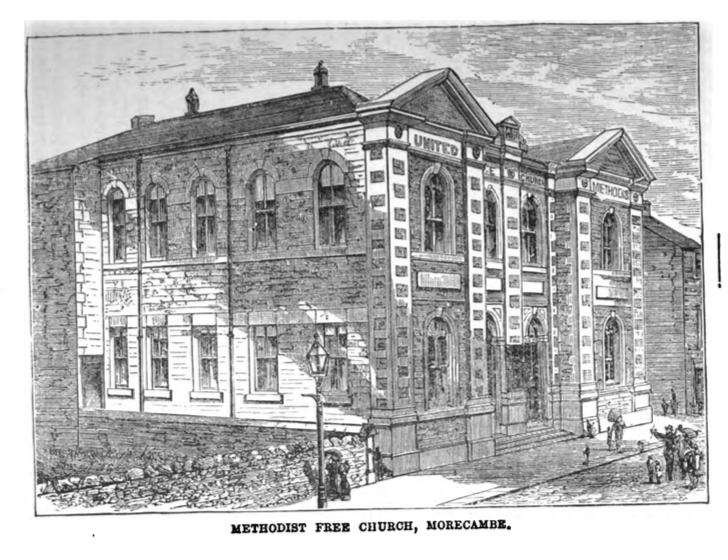
The society had been formed in 1874 by 44 members who had seceded from the Wesleyan chapel. They met from April 12th 1874 until 1876 in the Music Hall. The chapel was designed by Joseph Dixon of Morecambe, and opened on 18 October 1876. The opening was described in the UMFC Magazine in early 1877. At that point financial and practical difficulties had prevented the completion of the building, but by 1881 there was a growing society and a school numbering 270 scholars and teachers. S.W. was then able to report that with the help of the connexion and membership they succeeeded in erecting a chapel which would accommote 700. It was in the Corinthian style of architecture, and is described as compact, comfortable and well lit. They had a very handsome gas chandelier and galleries with an organ chamber and seats for the choir. The schoolrooms would accommodate 300 scholars.
Having described the building illustrated, S.W. goes on to tell us that it cost far more than anticipated, and there had been many difficulties. Instead of opening during the visiting season they had had to defer. He therefore finishes by exhorting members of the UMFC to visit Morecambe, attend the chapel and give generously.
The building was actually in Clarence Street, and it later years was well known for its “Fisherman’s Choir” In 1940 it was reported that it could accommodate 600.
Like most of the other six Methodist churches erected in Morecambe between 1850 and 1900 it is no longer open, closing in 1964. The building still exists, however, housing The Rainbow Centre, a social hub for the over 50s.
Reference
United Methodist Free Churches Magazine, v20, 1877 pp45-47
United Methodist Free Churches Magazine, v24, 1881 pp58-59
Comments about this page
For a photograph of the building as the Rainbow Centre in 1996 see Keith Guyler’s image at https://www.flickr.com/photos/britishmethodistbuildings/30152232688/in/photolist-28FTADZ-28YqWTN-2a4Ya3z-MWs5hQ-LiZmxn/
Lancashire Archives have recently made the baptismal register for 1876-1924 available on Ancestry https://www.ancestry.co.uk/search/collections/62471/
This article has been amended with further information.
Add a comment about this page